
MINERALIZATION
According to the Martin and Delgado (1995) Report, the Real del Castillo-El Alamo Region is bordered by the iron-gold belt to the west, the W Region at Sierra Juarez to the east, and placers Juarez and Campo Nacional also the east. Real del Castillo and some other mineral showings are included in the Mesozoic gold belt, but El Alamo is placed into the copper-gold belt, which ties south with Sierra San Pedro Martir.
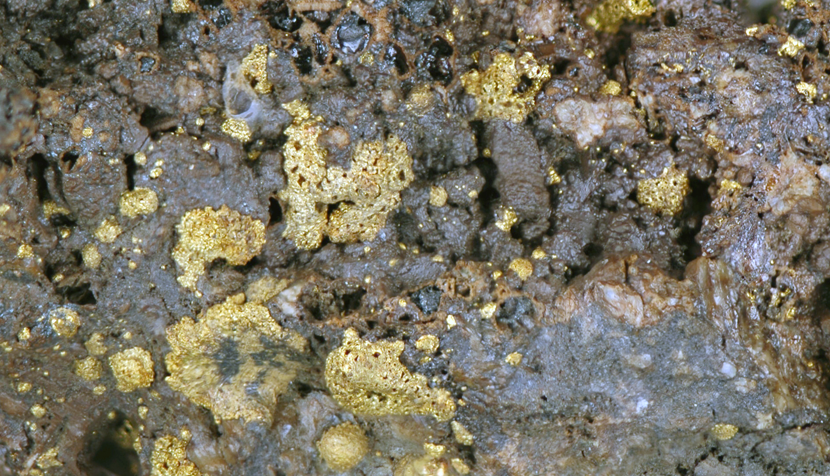
Mineralized veins strike South 40 to 80 degrees East, and dip 65 to 85 degrees Southwest, following an older dyke trend and are apparently cut by younger dykes. The whole set is hosted by a big quartz dioritic body. Tolman (1921) mapped more than twelve subparallel veins, anastomosed to branched. He also stated that veins were developed in four generations after the older mafic dykes' emplacement, from old to young in the following groups: (1) barren aplitic dykes (residual phase); (2) barren quartz veins (silicic phase); (3) quartz - tourmaline - biotite - epidote - clorite - magnetite - arsenopyrite (pneumatolithic to high temperature phase); and (4) native gold - quartz - pyrite - galena - minor magnetite-hematite veins (hypo-mesothermal phase).
Tolman also pointed out that gold-bearing quartz veins from group (4) developed the Princesa-Aurora system, which runs across the claim. Veins from group (3) should have minor gold values and barren veins from groups (1) and (2) are commonly closely related. This vein system seems to correspond with fissure filling, group (4) and (3) veins are economical, but group (3) veins could be sub economical and group (2) veins with magnetite-hematite have no value, although they could carry minor gold, zinc and lead values.
In the economical veins Tolman (1921) also recognized three types of unoxidized ore: (A) quartz and native gold, galena, and minor sphalerite, commonly grading to; (B) quartz and native gold, chalcopyrite, pyrite, magnetite and hematite; and (C) quartz and native gold with much magnetite and hematite, minor sphalerite, galena and pyrite. Gold occurs with magnetite, lesser with hematite and is associated with galena.
The visible gold is free and coarse in both oxidized and unoxidized ores, and gold values seem to be constant in both, so enrichment processes are not important. When manganese is present, gold tends to film fractures.
Copyright © 2020 Baja Gold Group All rights reserved.