
INTERPRETATION
The ore is hosted in a subsidiary fracture system developed along the contact between the quartzdiorite and the mafic dykes. The quartzdiorite or tonalite is a huge intrusive body emplaced deep into the earth probably more than 120 Ma ago. This body was under deformation and was sheared, developing a weakness zone used by dykes and hydrothermal solutions. Magma mixing processes probably occured in this area when the quartzdiorite was slightly cooled, being responsible for the mineralization stage, and continued later in the deformation stage.
Sheared and metamorphosed quartzdiorite indicates a weakness zone, which was used during the emplacement of both sets of dykes and veins. Complex dykes are those where two or more dykes are laying together. This zone struck North 40 to 60 degrees West, dipped 55 to 70 degrees Northwest, and was developed before or during older dykes emplacement. The vein attitude seems to depict a consequent fracture and fault system related to the main vein, striking South 40 to 80 degrees East, dipping 65 to 85 degrees Southwest. Younger mafic dykes used the penetrating system, which was traced by the older ascending path. Unsheared younger dykes suggest that they were intruded after deformation, and they seem to depict the last magmatic event.
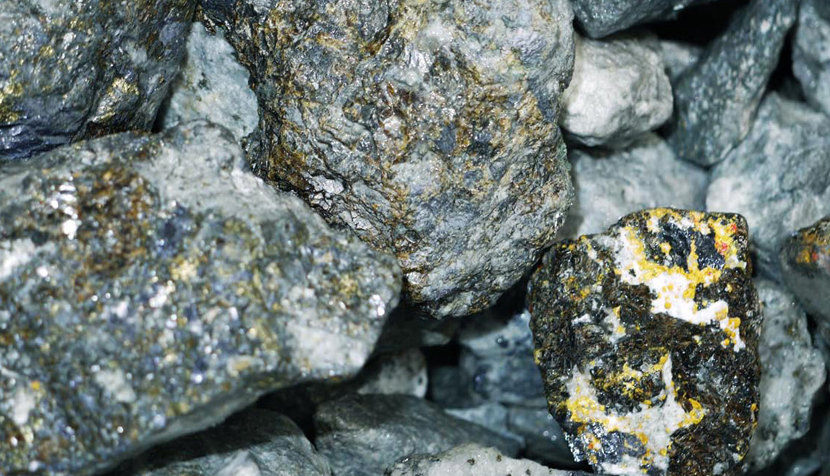
Because veins are also sheared they were emplaced during deformation, and because younger dykes cut the veins in some cases, it is important to understand and follow the ore after those frequent interruptions. The plunge or line of intersection between veins and dykes varies from 0 to 50 degrees Southwest, and it will help to define the direction of the movement in faulted veins. Veins are strong gold-quartz lodes with minor sulphides, especially galena, and one such ore can contain magnetite and hematite. Gold is free and visisble in all the ores. There is little change in gold content of the ores due to oxidation.
Veins are steep and 0.2 to 1.0 meters wide, filled with quartz, free gold, magnetite, and minor galena, sphalerite, chalcopyrite, pyrite, pyrrothite, and marcasite (Sagahon-Medina, 1982). Gold is free in contact with sulphides with values reaching almost 100 grams of gold per ton (Mohelman, 1935). Metallurgical tests suggests that the average grade, possibly in selected mineral, ranged between 52 and 72 grams of gold per ton. Amalgamation will free the gold, and cyanide is used to recover all the available gold (Edwards, 1993).
Placers vary from residual soil to 6 meters thick, but panning for free gold in a stream is an excellent exploration tool, because it will help establish the ore distribution. In this case, placers are below the La Princesa-Aurora veins system, but none is found on any of the eastern streams. Obviously, this suggests that there are no more veins above and to the south of the vein system, but if to the east it could mean that veins are cut and not just outcropings or that there was no structures or reception room available.
Electromagnetic studies suggest that anomalies are produced by mineralization below the surface. It's potential has to be worked, checked out by drilling in order to prove those exploration targets (Croff, 1992). (excerpted from the Geological Mineralogical Historical Evolution of Baja California, Edition 1997, by H. Romero and A. Medina, CICESE)
Copyright © 2020 Baja Gold Group All rights reserved.