LITHOLOGY
The whole region is covered with granitoids and metamorphic rock both intruded by mafic and felsic dykes. Interbedded schist and phyllites make the metamorphic section, probaby derived from interbedded sandstone and shale from Paleozoic to early Mesozoic miogeoclinal. Greenschist to low amphibolite facies were achieved under regional contact metamorphism during granitoid emplacement. Granitoids belong possibly to the western part of the Penninsular ranges batholith, ranging from gabbro and diorite to tonalite. Quarz diorites (tonalite) is the host rock at El Alamo, commonly sheared along the contacts with dykes and veins. Metamorphism and granitoids predated dyke emplacement, which occured around 100-120 Ma (Chadwick, 1987), because both are cut by dark and light dykes.
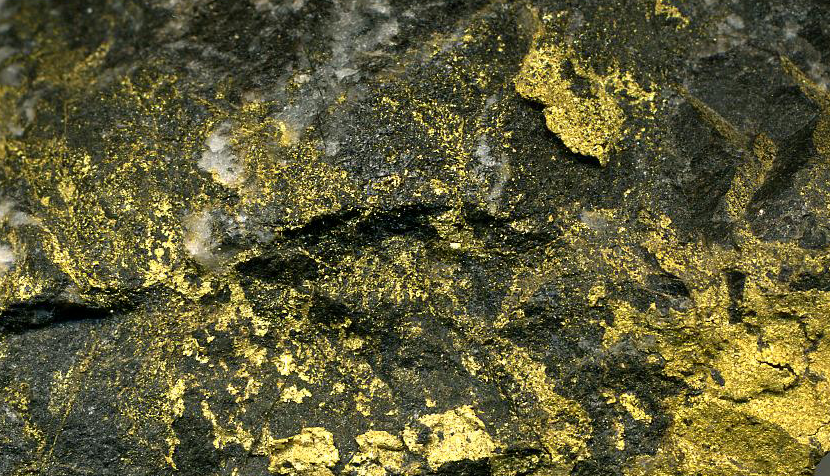
This region has undergone a strong erosion stage, which removed a thick rock-cover above the granitoids. During the late Cenzoic, weathering produced unconsolidated deposits filling the basins and major drainages. The region developed a structural block bounded by right-lateral movement active faults, such as Agua Blanca to the south, Tres Hermanos to the west, and Vallecitos to the east.
At El Alamo, Tolman (1921) noted that dykes can be divided into three groups, two mafic and one felsic. Mafic dykes make an interlocking and branching set, varying from 0.2 to 10 meters wide, bearing North 40 to 60 degrees West, dipping 55 to 70 degrees Northeast, and ranging from diabase to quartz dioritic porphry. Although both mafic dykes are sheared and sometimes complex, meanwhile younger are single unsheared dykes, occasionally cutting veins and older dykes. Felsic dykes seem to correspond to granitic aplites, predating young mafic dykes, possibly closely related and mistaken for veins, when parallel.
Copyright © 2020 Baja Gold Group All rights reserved.